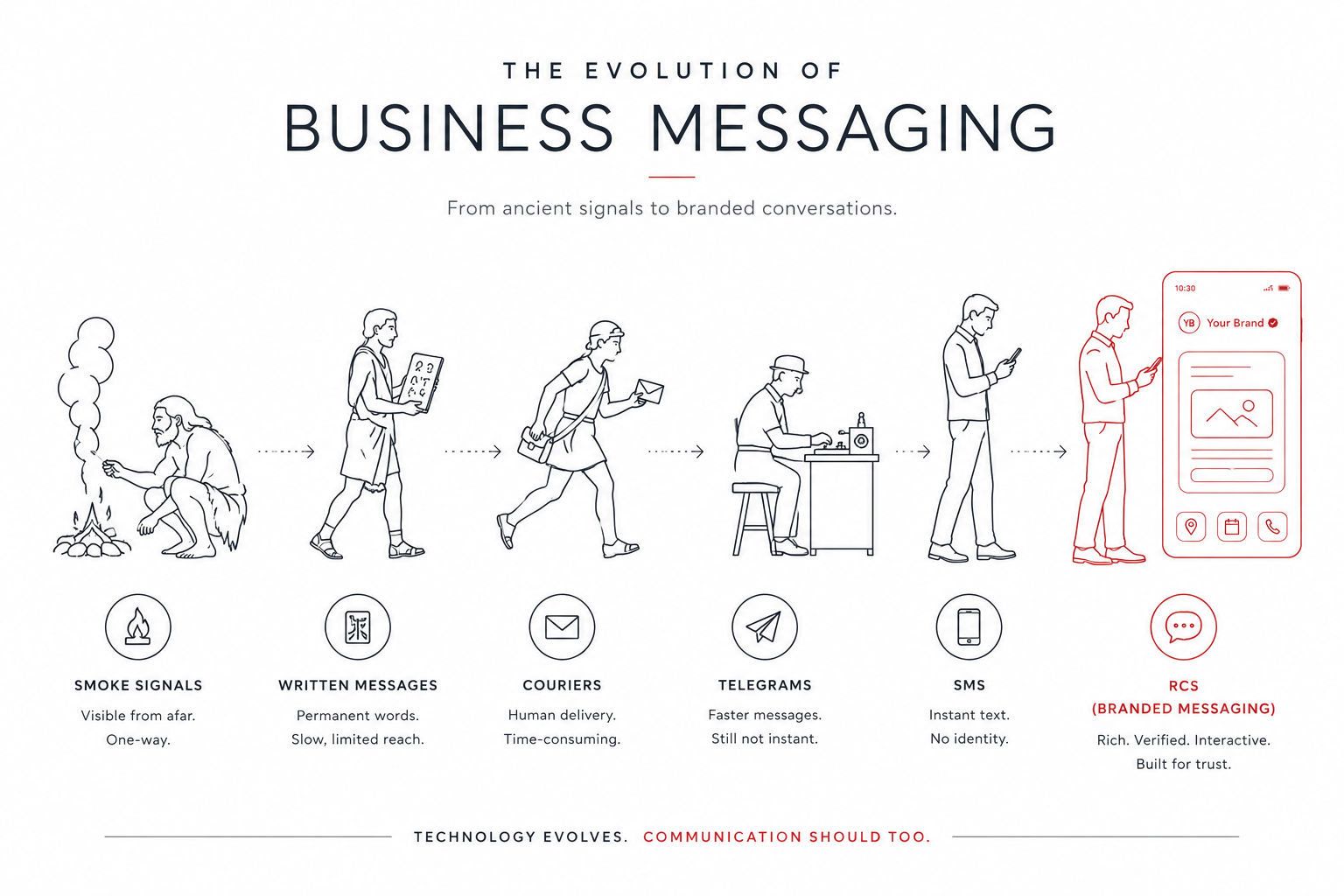
SMS was genuinely revolutionary.
Before the app store era, before push notifications, before the concept of a mobile-first customer journey — the text message was already there. Simple, fast, and uniquely universal. It required nothing from the recipient beyond a working phone number, and it reached them wherever they were. Businesses recognized this quickly. By the early 2000s, appointment reminders, bank alerts, and shipping confirmations were flowing through SMS at a scale that no other direct channel could match.
That simplicity was the product. SMS did not ask much of anyone — not of the sender, not of the recipient, and not of the infrastructure carrying the message between them. It was a 160-character window into direct communication, and for a long time, it was enough.
In many ways, it still is. SMS delivers. That matters, and it should not be understated. Any serious conversation about the future of business messaging has to start there — with honest acknowledgment that the channel we are evolving from still works remarkably well.
The same design that made SMS universal made it anonymous.
A short code — those five or six digit numbers that most businesses still send from — tells a customer almost nothing. No name. No logo. No visual relationship to the brand behind the message. Just digits and text, arriving from a sender who could be anyone.
For years, customers extended enough good faith to bridge that gap. They inferred context from message content. They recognized patterns. They trusted that a message about a delivery or an upcoming appointment was probably what it appeared to be.
That trust has eroded significantly. The same channel that businesses built their customer communication strategies around has become one of the most reliable vectors for scams, phishing attempts, and impersonation campaigns. Fraudulent messages mimicking banks, government agencies, and courier services have trained customers — systematically, over years — to approach unknown senders with caution rather than confidence.
Customers are still reading business texts. But they are reading them differently. There is a cognitive step now — a brief but real moment of evaluation — before the message content lands. Is this real? Is this from who I think it is? Is this safe to act on?
“The cognitive load of evaluating a message from an anonymous source now competes directly with whatever the message is actually trying to say.”
That friction is not hypothetical. It shows up in open rates, in click-through behavior, in the support calls that come in because a customer was not sure whether the message they received from a short code was legitimate. The invisible cost of anonymous messaging is not just engagement — it is trust, and once trust erodes in a channel, it does not recover on its own.
Business messaging is gaining an identity.
Branded messaging is not a new idea. The instinct to put a name and a face on business communication is as old as communication itself. What is new is the infrastructure that makes it possible at the carrier level — the ability to send a business message that displays a verified name, a recognizable logo, a richer presentation, and action buttons that let customers respond without leaving the message thread.
Technologies like RCS — Rich Communication Services — provide much of the technical layer that enables these richer experiences within the native messaging app on supported devices. But the technology is not the story. The story is what it makes possible: a business message that arrives with identity already established, so the customer can spend their cognitive energy on the content rather than on evaluating the sender.
A verified business name. A logo they recognize. Suggested actions they can take with a single tap. A message that looks like it came from the brand it claims to represent, because it actually did — and the carrier has confirmed it.
This is the shift. Not from text to video, or from push to pull, or from mobile to some other surface. From anonymous notifications to recognizable conversations.
The fall up from SMS.
Here is where the framing matters.
The transition from plain SMS to branded messaging is not a hard cutover. No carrier policy change will flip a switch and remove the text message from the world. SMS is embedded in billions of devices, in the muscle memory of customers who expect it, and in the operational infrastructure of companies that depend on it. The businesses sending A2P messages today are not looking to blow up their programs. They are looking to improve the customer experience within them.
The move to branded messaging is an evolution layer, not a replacement. When a customer’s device and carrier support rich messaging, they receive a branded experience — the business name, the logo, the richer presentation, the action button that lets them confirm, click, or respond without friction. When rich messaging is not available — because of the device, the network, or the carrier configuration — SMS fallback ensures the message still arrives. The information still travels. The campaign still moves.
This is the fall up from SMS.
“Better when possible. Reachable when necessary. Compatible with everything that already works, while opening the door to something meaningfully better.”
The phrase is deliberately optimistic. A fall is not a failure — it is a landing. And this particular landing is upward. The businesses that invest in branded messaging now are not abandoning their existing SMS infrastructure. They are building on top of it, improving the customer experience wherever improvement is possible, while preserving the universal reach that made SMS worth building on in the first place.
Trust becomes the platform.
The most important thing branded messaging does is not add a logo to a text message.
It restores trust to a channel that has spent the better part of a decade losing it.
Every scam text that mimics a courier. Every phishing attempt that impersonates a financial institution. Every message from an unknown number asking for a click — these are not edge cases. They are the daily operating environment that legitimate business messages now have to compete within. Businesses are not responsible for that environment. But they are living with its consequences every time a real transactional message gets dismissed, ignored, or reported as spam by a customer who could not tell the difference.
Verified sender identity changes the equation at the moment it matters most — before the customer has read a word. When a name they recognize arrives with a verified mark and a logo they know, they are not starting from zero trust. They are starting from a known relationship. The message is already contextualized. The evaluation work has already been done, at the carrier level, on their behalf.
This matters more, not less, as AI-generated fraud and messaging impersonation become more sophisticated. The businesses that establish verified, recognizable identity in their messaging programs now are not just improving their campaign metrics. They are building a trust infrastructure that becomes more valuable as the surrounding environment becomes noisier.
“Trust, in this context, is not a feature. It is the platform that everything else is built on.”
The most frequent touchpoint is also the least branded.
Brands invest significantly in recognition. The visual identity work, the years of advertising, the carefully designed digital experiences — all of it is oriented toward a single outcome: making a customer feel, at the moment of engagement, that they know who they are dealing with and why it matters.
Business text messages are often the highest-frequency direct contact a brand has with its customers. An appointment reminder. A shipping update. A fraud alert. A promotional offer. These messages arrive multiple times a month — sometimes multiple times a week — and they represent one of the most consistent brand touchpoints in the customer relationship. More frequent, in many cases, than the app, the website, or the physical store.
Yet most of them still arrive looking anonymous.
The disconnect is real. A brand that has spent years building recognition in every other channel shows up in the customer’s message thread looking like a random number. The customer has to do work — reconstructing the brand relationship from the message content alone — that they should never have to do. That work is not neutral. It costs attention, and attention is what everything in customer communication is ultimately competing for.
Branded messaging closes that gap. It does not require rebuilding programs or abandoning what works. It asks only that the identity a brand has already built be allowed to show up in the channel that reaches customers most directly.
Canada is worth watching closely.
Across North America, the momentum behind branded messaging is real and growing. The US market has moved quickly on A2P registration requirements, driving a more structured approach to business messaging identity at the carrier level. Canadian carriers are advancing their own RCS and branded messaging capabilities, on a timeline that is closer than most industry observers expect.
Canada is a particularly interesting market in this context. Canadian consumers have consistently ranked trust and privacy among their highest priorities in digital interactions. Canadian businesses operate under one of the most rigorous anti-spam frameworks in the world, through CASL, which means that the infrastructure for consent-based, identified communication already exists. The conditions for branded messaging adoption — a customer base that values trust, a regulatory environment that rewards identification, and a carrier ecosystem that is actively evolving — are arguably better in Canada than anywhere else on the continent.
The brands that recognize this moment and act on it are not just improving their messaging programs. They are establishing category leadership in a channel that is about to look very different from how it looks today.